Dear Colleagues,
I want to begin with a passage from our Middle States Self-Study Report that captures something essential about Montclair:
|
|
|
|
|
|
“From its earliest years, Montclair has been defined by its ability to adapt to changing social, economic, and educational landscapes. The University's story is one of continual reinventions in response to both long-term trends and urgent disruptions, enabling it to thrive as a catalyst for academic excellence, social mobility, and community engagement.”
|
— Middle States Self-Study Report (2025)
|
|
|
|
I see this narrative echoed in reports across our departments and colleges, and it never ceases to fill me with inspiration and pride.
The narratives we create about ourselves are both reflective and projective. They help us understand where we have come from, but they also orient us toward where we aspire to go.
At a time of rapid change, our capacity to reinvent ourselves while preserving our core mission is essential. As a university, we are at our best when we make our students and each other see that the future is not predetermined. We have the agency to imagine what could be different, and the responsibility to develop the knowledge, judgment, and capacity to help make those possibilities real.
Scholarship is how we exercise that agency. In every discipline, we do more than create and share knowledge. We surface possibilities that were previously invisible, ask new questions, and challenge what we thought we knew. We also make visible the social, economic, technological, political, cultural, and institutional forces that shape—and sometimes constrain—our imagination.
A historian shows us that something we regard as inevitable was once a choice. An economist helps us understand the incentives that sustain a particular system. A sociologist reveals the structures and relationships that shape individual opportunity. A scientist illuminates processes invisible to the naked eye. An artist helps us see a familiar world differently. A philosopher asks whether what we can do is what we should do.
Sometimes our work expands possibilities by revealing what could be; sometimes it helps us see what stands in the way. In either case, scholarship expands our horizon. It helps us see beyond the limits of what we currently know, imagine, or consider possible. This is one of the great gifts of a university.
The upcoming speakers in our World Wide of Ideas series invite us to do precisely this, each in a different way.
Mark Peres (October 27) asks us to consider whether our ethical framework is adequate in a world increasingly populated by forms of machine intelligence—expanding our notion of responsibility to include the technologies we create and challenging the stories we tell about our place in the world.
Byron White (December 9) offers a different way of thinking about the role of higher education. He argues that the institutions best positioned to navigate this moment will be those willing to move beyond safe, incremental adjustments and organize their work around a community-rooted purpose. Contrasting optimization with transformation, he illustrates how starting from a different premise can change the challenges institutions choose to address, and the possibilities they pursue.
Both speakers challenge us to question an assumption, look at a familiar problem from another angle, or imagine a possibility that might not otherwise have occurred to us.
This brings us to innovation. Innovation is much more than an artifact we create in a makerspace. It is the capacity to see beyond constraints, the ability to imagine that something could be different, and the confidence to make it so.
This broad understanding of innovation sits at the heart of our Honors Program. In his guest editorial below, Jeff Strickland describes how Honors EDGE is turning that understanding into practice—connecting creative inquiry to civic learning and democratic participation.
Our daily work of expanding imagination and adapting to changing reality is happening everywhere across Montclair. I want to share this work. If you are leading a project that challenges assumptions, reimagines a process, or expands what we believe possible, send us a 1-paragraph description. We will feature compelling examples in upcoming issues.
With my best regards,
Fatma
|
|
|
|
Learning Democracy by Doing
|
By Jeff Strickland, Assistant Provost for Honors EDGE
|
|
|
|
Democratic backsliding around the world makes civic education especially urgent. V-Dem’s 2026 report identifies 44 countries experiencing democratic backsliding in 2025, part of a global trend of democratic decline that has dominated since the early 2010s. Civic education must move beyond transmitting information about American history and government. Students need to interpret evidence, understand how institutions work, examine who holds power and who bears the consequences, and deliberate across differences. They also need opportunities to participate in democratic life. Through that practice, civic participation can become experiential learning.
|
|
|
|
|
Research points to reduced instructional time and uneven opportunities to practice civic skills. The Brookings Institution’s 2018 Brown Center Report described how accountability policies that emphasized tested subjects contributed to reduced time for social studies. A 2025 Brookings interview with education researcher Rachel Perera examined how politicized curriculum debates can lead teachers to self-censor or avoid controversial topics. Kathleen Hall Jamieson identified related obstacles, including low policy priority, limited funding, unequal access, and disagreement over what civics should teach. A 2020 CIRCLE survey found that only 52% of enrolled, voting-age young people recalled learning in college how and where to register to vote.
Participation data help show where those opportunities could matter. The Census Bureau’s 2024 survey estimated that 72.5% of New Jersey citizens of voting age voted, compared with 65.3% nationally. In both places, the reported rate rose with age. In New Jersey, the estimate reached 52.4% for ages 18–24 and 84.7% for ages 65 and older; national estimates reached 47.7% and 74.7%, respectively. These figures come from a survey rather than election-office counts, and the margins of error run wider for younger New Jerseyans. Beyond voting, the 2023 Census and AmeriCorps survey estimated that 56.6% of New Jersey adults voted in a local election, 8.8% contacted a public official, 11.2% attended a local public meeting, and 23.3% took action with neighbors.
These rates show how often people participate, but they do not capture what people learn through participation. Alexis de Tocqueville’s account of local self-government offers a way to understand that learning. In Democracy in America, he wrote, “Local assemblies of citizens constitute the strength of free nations. Town-meetings are to liberty what primary schools are to science.” Tocqueville saw local government as a place where people could practice self-government while addressing shared concerns. His account also requires historical context: many people in his era lacked political rights and access to those institutions.
Heather Cox Richardson offers a contemporary perspective on democracy as an unfinished project. In a Brookings interview, she described American democracy as “always a work in progress,” shaped by generations who invoked the Declaration of Independence to press for broader inclusion. Richardson’s observation reinforces the value of civic participation across generations: democratic ideals gain meaning through the people who use them to shape public life.
The American Experiment, which I co-teach with President Jonathan Koppell, connects historical and institutional knowledge with public reasoning. Our discussions have included Tocqueville’s argument that local public life teaches democratic habits. In groups of seven, students investigate a challenge facing American democracy, develop a historically informed, evidence-based proposal for reform, and weigh competing perspectives and tradeoffs. On December 8 at 2 p.m., the groups will present their commissions at a Constitutional Convention and Democracy Summit in Presentation Hall.
This work also connects civic learning with Honors EDGE’s Creativity pillar and its broader commitment to innovation. Democratic challenges ask students to define complex problems and understand the people and institutions involved. Creative inquiry encourages students to question assumptions, examine issues from multiple perspectives, and develop innovative responses while weighing the consequences of proposed changes. That approach aligns with AAC&U’s Creative Thinking VALUE Rubric, which emphasizes imaginative work, original synthesis, and divergent thinking. In The American Experiment, students bring historical evidence and institutional knowledge to that process as they develop their commissions. Across Honors EDGE, students can apply creative problem-solving to public challenges and bring their ideas into conversation with the communities and institutions those ideas may affect.
Civic participation offers students another form of experiential learning. Students deepen their understanding when they investigate public problems, assess evidence, listen to different perspectives, deliberate with others, and present possible solutions. High-impact practices such as community-based learning and collaborative projects can connect coursework to public issues and give students meaningful ways to participate in community life. These experiences also connect with the Transformations pillar. A recent study of undergraduate civic-engagement projects found that students developed a stronger sense of civic agency and learned to connect individual action with broader change. The authors base their findings on student reflections and project outcomes at one regional public university, so the study offers a relevant example rather than a direct prediction of Honors EDGE’s effects.
Building on the Community pillar, we are exploring ways to extend students’ engagement into civic and democratic life. Students could attend a school board, town council, or planning and zoning board meeting, or observe a state or federal legislative hearing, in person or online. They could also speak during public comment, submit written comments, or reflect on how public decisions unfold, whose voices shape them, and how community members can influence outcomes. This work would connect community engagement with the public institutions and processes that shape community life.
Honors EDGE brings an innovative approach to civic learning by connecting creative inquiry, collaboration, and engagement in community life. Students can carry ideas from coursework into public settings, consider how different groups experience public decisions, and reflect on ways to influence outcomes. The Creativity, Community, and Transformation pillars frame this work as both intellectual exploration and engaged learning. Faculty from across Montclair State contribute to Honors EDGE’s curriculum and programming. Their disciplinary perspectives help students approach democratic challenges from multiple angles and strengthen connections among the three pillars.
AASCU’s American Democracy Project offers a national example of higher education’s role in this work. Its nonpartisan network connects nearly 300 state colleges and universities committed to preparing informed, active citizens who engage with different viewpoints. The project’s priorities include civic literacy, bridge-building, student voice, and universities’ roles in their communities. For Honors EDGE, extending civic participation through the Community pillar could connect students’ academic work with sustained attention to public institutions and community concerns.
Students learn democracy by studying its history and institutions, investigating public problems, and practicing informed participation with others. By bringing the Creativity, Community, and Transformation pillars together with faculty expertise from across Montclair, Honors EDGE can connect creative problem-solving with civic engagement and help students carry their learning into public life. We can create more opportunities for students to shape their communities through informed, collaborative participation.
|
Jeff Strickland, Ph.D.
Assistant Provost for Honors EDGE
|
|
|
|
|
President Koppell's Lecture Series
|
|
|
|
|
Information, Power, and Democracy: The First Amendment
|
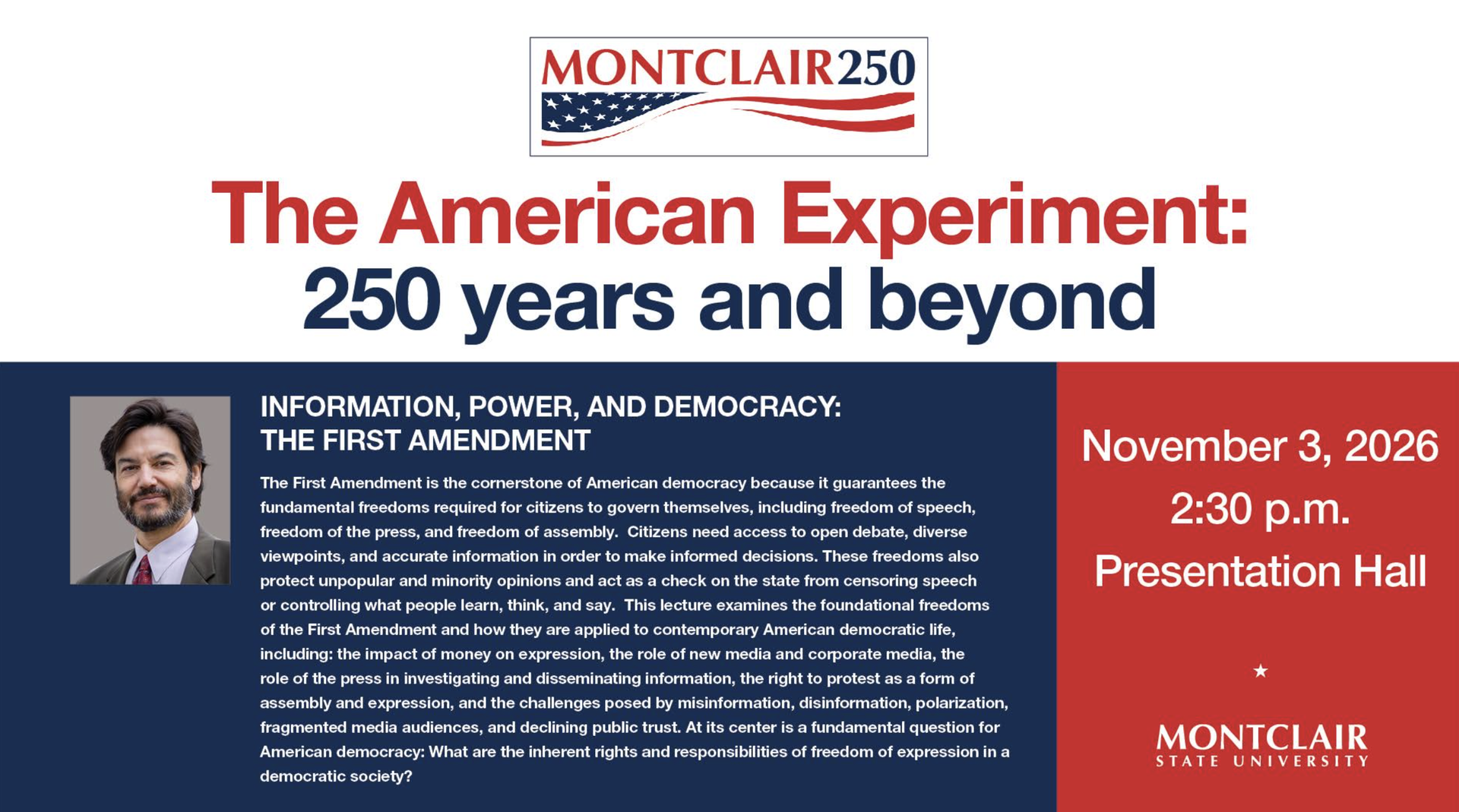
President Koppell's The American Experiment: 250 Years and Beyond lecture series concludes for the semester with "Information, Power, and Democracy: The First Amendment" November 3, at 2:30 p.m. in the College of Communication and Media's Presentation Hall.
The First Amendment shapes how we share ideas, challenge those in power and make our voices heard. But how do we protect those freedoms when misinformation spreads and trust in the media declines? Join for a timely exploration of the rights and responsibilities of free expression and what they mean for democracy today.
|
|
|
|
Rethinking Our Place in the Age of AI
|
Join us this afternoon, October 27, for the inaugural event of The Wide World of Ideas, a new speaker series bringing our community together to explore timely questions and ideas shaping our world.
Educator, ethicist and author Mark Peres will lead "A New Story for the Age of AI: When Intelligence Is No Longer Exclusively Human," exploring how increasingly capable AI is challenging long-held distinctions between person and tool, relationship and simulation, autonomy and dependence—and what those shifts may require of our ethical frameworks.
The presentation will take place from 4–5 p.m. in the Feliciano School of Business, Room 140, with time for dialogue and Q&A. An informal reception and book signing of The Accord will follow from 5-6 p.m., offering opportunities to connect with Mark Peres. Complimentary copies will be available to the first 50 registrants. Register early and join the conversation.
|
|
|
Celebrate Our Graduates at Winter 2027 Commencement
|
|
|
Graduate Micro-Internship Applications are Now Open
|
Eight projects in the Graduate Center's FY27 Micro-Internship Program are accepting applications from eligible graduate students, with three more Fall 2026 projects coming soon. Spring 2027 projects are under review and will be posted in November.
Please share these on-campus professional development opportunities with your graduate students and encourage them to check the Graduate Center's monthly newsletter for application details.
|
|
|
|
|
Help Students Experience Government in Action
|
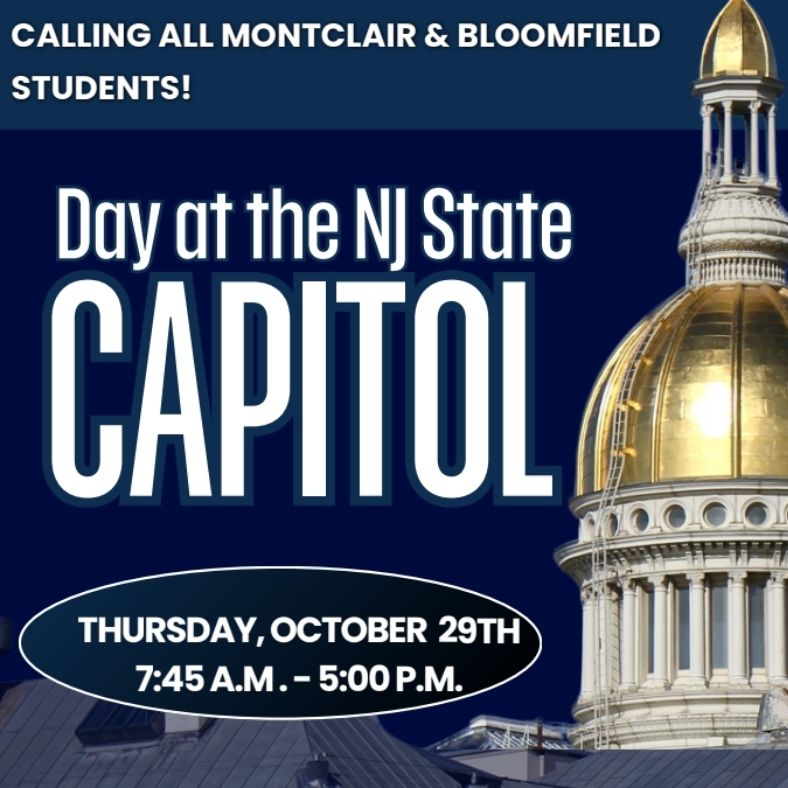
Please share this opportunity for students to spend a day inside the New Jersey State Capitol on Thursday, October 29, from 8 a.m. to 5 p.m. During this immersive visit, students will tour the Capitol building, observe committee hearings and live testimony, and connect with legislators and other public-service professionals.
Transportation and lunch are included at no cost, with buses departing from the Red Hawk Deck and the Bloomfield Campus. Encourage your students to register.
|
|
|
|
|
|
Join the Dialogue at Navigating Intersections 2026
|
Join colleagues from across the University for the annual Navigating Intersections Conference on Thursday, October 29, from 9 a.m. to 1 p.m. in the University Hall Conference Center.
Centered on this year's theme, "Unity, Peace & Well-Being," the conference will feature the "Inclusive Whole Person Well-Being Model" and an overview of the Penn Resiliency Program through speakers, a community panel and breakout sessions. Registration is required.
|
|
|
|
|
|
Put Effective Communication into Practice
|
Strengthen your Effective Communication capability through an interactive, in-person RealTalk @ Montclair experience at Van Fossan Theatre on the Bloomfield campus, Wednesday, November 11, 10 a.m. to 12 p.m.
Through three engaging activities, you will explore how communication styles, delivery and tone shape workplace interactions and practice communicating with greater intention and clarity. Space is limited and registration is required.
|
|
|
|
|
|
Congratulations and Kudos
|
|
|
|
Introducing the Inaugural Presidential Fellows
|
Congratulations to the Office for Experiential Education and Career Connections on launching Montclair's inaugural Presidential Fellowship and selecting eight students to work alongside executive leaders on institutional priorities. Through mentorship and hands-on projects, Fellows will contribute their perspectives while gaining experience across the University's divisions.
A special welcome to Alias Ragsdale (Social Media and Public Relations) and Jackie Valdivia (Business Administration-Marketing), who will support the Office of the Provost.
|
|
|
Celebrating Graduate Student Excellence
|
Congratulations to the Fall 2026 inductees of Alpha Epsilon Lambda, the national graduate student honor society. Faculty and staff are invited to celebrate their achievements at the induction ceremony on Wednesday, November 4, at 6 p.m. in the University Hall Conference Center, followed by a reception.
|
|
|
|
|
'Thinking Together' with Interim Provost Mili
|
|
|
|
Some of the most interesting ideas begin with a question, a curiosity, or a conversation that has no predetermined outcome. I am setting up a biweekly time for us to step away from the everyday and spend some time exploring questions and possibilities that matter to the university.
Every other week, we’ll gather for an informal conversation around a question, an idea, or something worth wondering about. There will be no presentation and no expectation that we arrive with answers—just an invitation to think, listen, and explore together.
Interested in joining? Sign up here.
|
|
|
|
|
|
|
Explore Previous Editions
|
|
|
|
|