Dear Colleagues,
Yesterday, we held the President’s semi-annual Academic Leadership Council, bringing together deans, chairs, directors, and other leaders from across Academic Affairs to share news, exchange ideas, and tackle shared challenges.
The meeting centered on our collective role in advancing the university’s vision and priorities. Academic Affairs is central to each of the four priorities, including the fourth, Build Institutional Strength and Resilience, a foundational priority, at a time when many institutions nationwide are struggling with financial viability. Since April, the Chronicle of Higher Education has chronicled universities, large and small, making deep cuts and taking drastic measures. Montclair State University’s strong standing is not an accident; preserving it requires vigilance, innovation, and flexibility. And this was the topic of our conversation.
We started with discussing what motivates our work. We built on Daniel Pink’s book and TED talk on what truly drives high-level work. In contrast to the “Industrial Age,” where mechanical tasks were rewarded with piece-rate pay, the “Creative Age” depends on Autonomy, Mastery, and Purpose. People choose higher education because of its mission, its intellectual freedom, and the opportunity for lifelong learning. Faculty, staff, and administrators join Montclair State University motivated by that mission. Our role as leaders is to build on that motivation and surround them with the conditions for success—to nurture a sense of higher purpose and long-term thinking.
|
|
|
|
|
We used the Cathedral Thinking metaphor to further highlight the focus on long-term, multi-generational impact of our work, and honor the sense of higher purpose that animates us. Research on motivation also reminds us that “itemizing” work and rewarding individual tasks can have drastic negative impact on intrinsic motivation and creativity. As Antoine de Saint‑Exupéry wrote, “A rock pile ceases to be a rock pile the moment a single man contemplates it, bearing within him the image of a cathedral.” When we reduce that cathedral to a checklist of tasks, we risk turning it back into a pile of rocks.
We then focused on agility and innovation. President Koppell posited that universities falter when they persevere with the status quo and wait too long to acknowledge changing realities. Once they start feeling the financial consequences, it is too late. The best way to preserve sustainability is to prepare from a position of strength.
|
|
|
|
The second challenge universities face in innovating is what he called the Ivory Cage, drawing on DiMaggio’s work on institutional conformity and uniformity. Universities often adopt sector norms even when those norms no longer serve them. Several forces push us toward sameness—some real, some perceived; some external, others self‑imposed; some immutable, others entirely surmountable. We cannot evolve the university without identifying these forces and deciding which to work with and which to defy.
We discussed several of these forces, including fear of reputational risk, adoption of definitions of excellence that don’t fit our context, and norms deeply embedded in our systems and processes.
We then discussed tools we can use to free us from the forces of conformity. Redesigning organizational structures allows us to rethink roles, resources, and processes to better support innovation. Partnering with institutions willing to experiment outside traditional norms expands our perspective. Montclair State University has joined the Future Universities Alliance, a network committed to building structures and processes that meet the needs of the future. To nurture institution‑wide innovation, we are launching a space to incubate new ideas and experiments focused on institutional change.
Our resilience is built, not inherited. By nurturing intrinsic motivation, aligning our structures, and scaling innovation, we ensure Montclair remains strong for generations.
Thank you to everyone at the meeting for the lively engagement and thoughtful ideas. Looking forward to continuing this conversation and turning it into many actions.
Best regards,
Fatma
|
|
|
|
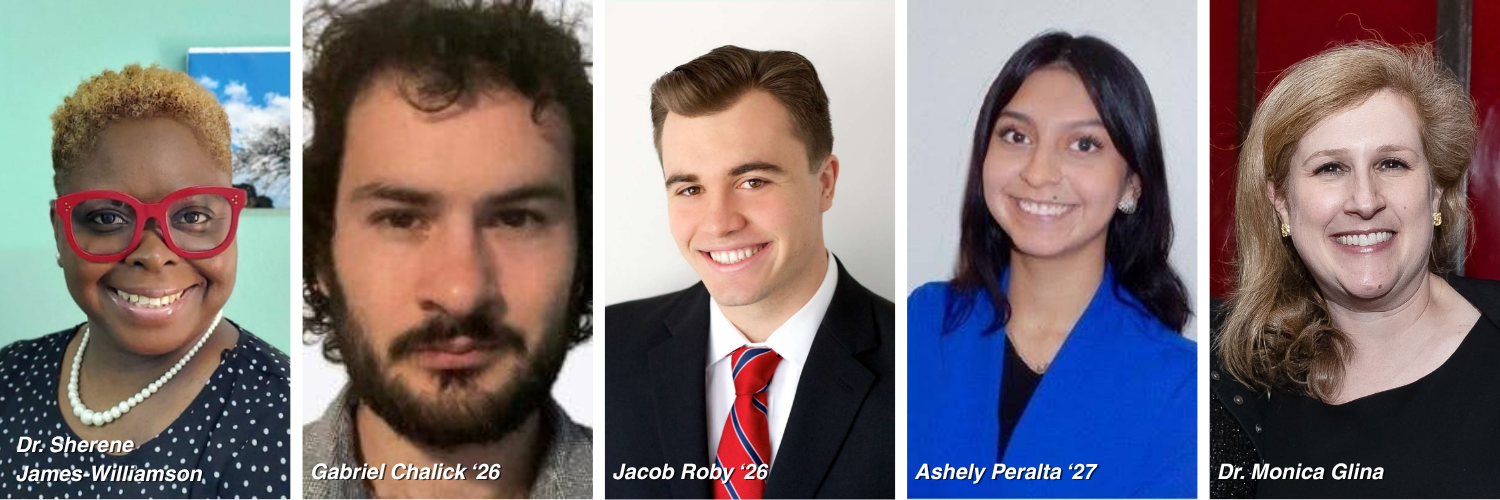
Montclair has been awarded a Fulbright Scholar-in-Residence for 2026-27—the first in the University's history. Dr. Sherene James-Williamson of the University of the West Indies in Kingston, Jamaica, will direct upper-level seminars in geoheritage, cultural heritage, and geoarchaeology. While on campus, she will also share her research at open forums and engage with community partners such as the East Orange STEM Academy. Her interdisciplinary work will connect with the Departments of Anthropology, Classics, and Earth & Environmental Science, and CHSS’s Center for Heritage and Archaeological Studies. Dr. Peter Siegel (ANTH), Dr. Tim White (International Academic Initiatives), and several other key faculty brought this to fruition over many months of collaborative work.
Music graduate student Gabriel Chalick was named Fulbright US Student Program Finalist and will spend 2026–27 in Paris pursuing research and creative work. Martinson Honors EDGE student Jacob Roby earned a Critical Language Scholarship to study Mandarin Chinese in Taiwan, and Ashely Peralta received a $4,000 Gilman Scholarship to support her Fall 2026 study abroad experience in Tokyo. Dr. Monica Glina, a longtime instructor in the Department of Educational Foundations, was selected as Fulbright U.S. Scholar Program Finalist, for work at the University of Alcalá in Spain. Montclair will also welcome Evita Meiersone (not pictured) of Latvia to the Cali School of Music this fall as a Fulbright Foreign Student Program Finalist.
|
|
|
|
- Montclair State University Network for Educational Renewal (MSUNER) Summer 2026 Conference: There's still time to register for this summer's conference, The Reasons Teachers Stay, Friday, June 26, 9 a.m. - 3 p.m., University Hall, Conference Center.
- CETL Fellowship 2026-2028 Applications: Applications for interested faculty looking to join this community of practice close Tuesday, June 30.
- CIM Programs Implementation Open Forum: Join the next open forum on CIM Programs, the University's new program management system, Monday, July 13, 2 p.m. on Zoom; faculty and staff may also submit questions and feedback through this form.
- Annual Student Supervisor Conference: Faculty and staff who supervise student workers are invited to attend this year's conference for resources and support in management, recruitment and technology, Wednesday, July 15, 10 a.m. - 2 p.m., in the Student Center, Ballrooms.
|
|
|
|
|