Dear Colleagues,
Last week, I wrote about Montclair’s formative role in the lives of our students. But universities are formative in another sense as well: through research, scholarship, and creative activity, they shape the broader social, cultural, scientific, and technological landscape.
This facet of our work energizes faculty and students, and it often defines how institutions are recognized and understood. Yet a research enterprise cannot simply be designed from the top down; it emerges from a complex system of expertise, affinities, infrastructures, incentives, collaborations, and shared aspirations. Over time, that system gives each university its distinct research identity and signature.
As a relatively young research university, Montclair has an extraordinary opportunity to shape that identity intentionally. We are not starting from a blank slate. We are already a Carnegie R2 university with an impressive trajectory, but we also have an unusual opportunity to shape what comes next. Our opportunity is to build a research identity rooted in Montclair’s public mission: interdisciplinary, regionally engaged, community-connected, and oriented toward problems that matter.
|
|
|
|
A Research Model that Fits Our Mission
|
|
|
- A New Social Contract: The 1945 model gave science considerable autonomy from immediate societal demands in order to protect basic research. The next 75 years call for a new social contract in which research is more directly connected to the public challenges it can help address.
- Convergence Research: Today's complex challenges—such as climate adaptation, pandemic readiness, and algorithmic bias—do not respect departmental boundaries. Addressing them requires deep, interdisciplinary convergence.
- Embedded Regional Innovation: True innovation requires expanding regional ecosystems and supporting institutions deeply embedded in diverse communities. Our research agenda must capitalize on the rich tapestry of our faculty, students, and regional context.
- Co-Creating with Communities: Breakthroughs occur when researchers co-create priorities alongside affected communities from day one. This principle sits at the heart of our identity as an institution holding Carnegie designations for Community Engagement and Leadership for Public Service.
|
Taken together, these principles describe a research university deeply connected to its region, committed to societal impact, grounded in community partnership, and structured for interdisciplinary discovery. They also offer a useful lens for thinking about the research identity we want to cultivate at Montclair.
|
|
|
From Great Ideas to Great Proposals
|
|
|
From silos to convergence. Illustration via Canva.
|
|
|
|
This philosophy directly informs our internal efforts to support faculty research. Last spring we issued a call for Research & Innovation Institutes. We received proposals from 17 multidisciplinary teams. The Vice Provost for Research, Stefanie Brachfeld, formed a review committee. I am deeply grateful for the enthusiasm of the faculty who responded and impressed by the diversity of the topics, all reflecting our character, our times, and the challenges we face. The guest feature by Dr. Brachfeld below discusses these proposals and next steps in more detail.
The proposals taught us at least two things: First, we have an excellent foundation on which to build. The expertise, the passion, and the nature of the problems addressed are full of promise. Second, they taught us something important about our role: promising interdisciplinary ideas rarely arrive fully formed.
They require time, sustained conversation, intellectual exchange, and iterative refinement to become compelling research programs that can attract external support and make a meaningful difference. Faculty need space to find collaborators beyond their home departments, test new concepts, refine research questions, and imagine what a collection of individual insights might become when united around a shared societal problem.
|
If we want to build a stronger research enterprise, we cannot simply wait for polished proposals to land on our desk. We must actively create the conditions that help great ideas become great proposals—converting individual scholarly strengths into collective intellectual capacity.
I look forward to seeing these initiatives take shape under the leadership of Vice Provost Stefanie Brachfeld. I want to express my deep gratitude to everyone who submitted a proposal, as well as the committee members—including our student reviewers—who invested significant time providing thoughtful, detailed feedback.
The work of building a research enterprise is never finished. It requires sustained attention, investment, and the willingness to learn from both successes and setbacks. But I am increasingly convinced that our public mission can become the organizing principle for the research university we become.
|
Individual insights coalesce into collective impact. Illustration via Canva.
|
As we move forward, I hope faculty, staff, students, and community partners will see themselves as part of this work. The question before us is not only which institutes or initiatives we create, but how we cultivate a research culture worthy of Montclair’s mission: ambitious in its scholarship, generous in its collaborations, and consequential for the communities we serve.
With warm regards,
Fatma
|
|
|
Research & Innovation Institutes: Inaugural Competition and Next Steps
|
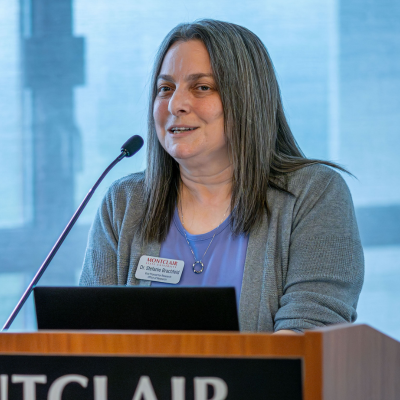
By Stefanie Brachfeld, Vice Provost for Research
|
|
|
|
Last fall and spring, faculty teams from across the University responded to the inaugural Call for Proposals for Research & Innovation Institutes. The proposals reflected a broad range of interdisciplinary interests and demonstrated significant enthusiasm for developing collaborative research, scholarship, and community-engaged activities around important societal challenges.
Following a comprehensive review by a joint faculty, student, and administrator committee and consideration by Provost Mili, multiple teams have been invited to move forward as University Research Initiatives to further develop their concepts through a series of University-supported activities. These initiatives and their proponents will be announced once all have confirmed their participation in the process.
|
|
|
|
|
The inaugural competition provided insight into how the University can best support the development of new interdisciplinary research entities and create a pathway for future Research & Innovation Institutes. The teams will participate in a structured development process designed to expand interdisciplinary participation, develop a shared collaborative research agenda, establish priorities and measurable outcomes, and build strategies for external funding, philanthropic support, and community partnerships to support long-term sustainability. These activities will provide opportunities for members of the University community whose interests align with the identified themes to become involved, and help to build collaborations across colleges, schools, disciplines, and campuses. The Office of Research in partnership with the Provost’s Office, Government Relations, University Development, Community Engagement, and other campus collaborators, is developing the activities and schedule for this next phase. Recognizing that a research institute is just one of several possible models for supporting compelling and innovative ideas, these activities will also explore the optimal organizational structures and approaches best suited to advancing each team’s goals. Additional information will be shared as plans are finalized.
We extend our sincere thanks to all of the faculty and staff who contributed ideas to this inaugural competition and to the members of the proposal review committee for their time, expertise, and thoughtful feedback they provided. The proposals and review process have helped identify areas of opportunity and will inform the University's continuing efforts to strengthen interdisciplinary research and scholarship and advance the University’s research enterprise.
|
Stefanie Brachfeld, Ph.D.
Vice Provost for Research and Interim Head of the Graduate Center
|
|
|
Montclair Selected for Participation in the NSF-Funded HACU's VOLARÉ Institute
|
Montclair State University has been selected to participate in the third cohort of the Hispanic Association of Colleges and Universities' (HACU) Visioning, Organizing, Leading, and Advancing the Research Enterprise (VOLARÉ) Institute. This competitive, yearlong initiative supported by the National Science Foundation will pair Montclair leaders who support research and faculty development leaders with mentors from institutions who have recently expanded their own research enterprises.
Through the Institute, the Montclair team will work alongside expert higher education leaders and research administration professionals from across the country to strengthen the University's research infrastructure, expand participation in STEM and develop sustainable strategies for increasing competitiveness for external funding. This is a wonderful recognition of Montclair's growing research enterprise and its commitment to expanding opportunities for faculty, staff and students.
|
|
|
|
|
|
'Thinking Together' with Interim Provost Mili
|
|
|
|
Some of the most interesting ideas begin with a question, a curiosity, or a conversation that has no predetermined outcome. I am setting up a biweekly time for us to step away from the everyday and spend some time exploring questions and possibilities that matter to the university.
Every other week, we’ll gather for an informal conversation around a question, an idea, or something worth wondering about. There will be no presentation and no expectation that we arrive with answers—just an invitation to think, listen, and explore together.
Interested in joining? Sign up here.
|
|
|
As the new academic year approaches, explore practical tools, timely resources and support to help you prepare, plan ahead, and start the semester strong.
|
- Assignment, Syllabus, and Course Review Support
|
Whether your syllabus and assignments need a complete overhaul or a few thoughtful updates, the Office for Faculty Excellence offers a "no judgment, just help" review and redesign service for faculty of all ranks and disciplines. You can also use the Pre-Term Teaching Checklist to make sure your courses are ready for the semester ahead.
|
- Map Out Your Fall Writing Projects
|
Start the semester with a realistic approach to scholarly writing at this online OFE workshop, this Friday, August 28, 10-11 a.m. Learn how to protect writing time, work around competing demands and build achievable timelines around your fall schedule. Register for the workshop here.
|
- Plan Ahead with the Academic Personnel Calendar
|
Stay ahead of key faculty and administrative deadlines by adding the Academic Personnel calendar directly to your Google Calendar. Important dates will remain easily accessible throughout the academic year.
|
- Stay Ahead of New Funding Opportunities
|
|
|
Stay ahead of upcoming funding opportunities with weekly updates from the Office of Sponsored Programs. Each email highlights opportunities from federal and state agencies, private foundations, professional organizations and other sponsors. To join the Funding Opportunities email list, send a request to osp@montclair.edu.
|
|
|
|
- Thursday, August 27: President Koppell's Opening Day Town Hall, 11 a.m., Alexander Kasser Theater.
- Friday, August 28: First day of classes in Sessions A and B.
- Wednesday, September 2: New round of SEEDS Course Certification begins.
- Monday, September 7: Deadline to register your department or office for the University Street Fair at Homecoming on Saturday, October 3.
- Wednesday, September 9: Deadline to register as an employer for the Part-Time Student Job Fair on Wednesday, September 16.
- Thursday, September 17: 2nd Annual Sabbatical Reception, co-hosted by University Libraries, 3-4:30 p.m., Sprague Library, First Floor Reading Room.
|
|
|
|