Dear Colleagues,
Our mission statement begins with the affirmation: “Montclair State University is a public-serving institution advancing the common good.”
I love this statement, and I have come to appreciate its depth and sincerity here at Montclair. Yes, we contribute to the public good through education and research. But more than that, Montclair sees itself as part of a higher education ecosystem. We have a stake in the health of this ecosystem, and take responsibility for it.
In Scale, physicist Geoffrey West examines the dynamics of growth and sustainability across living organisms, companies, and cities. All human made systems (businesses) become increasingly uniform and rigid as they age, leading to their death. Cities are the exception. As they grow, they become more, not less diverse and more generative and vibrant.
|
|
|
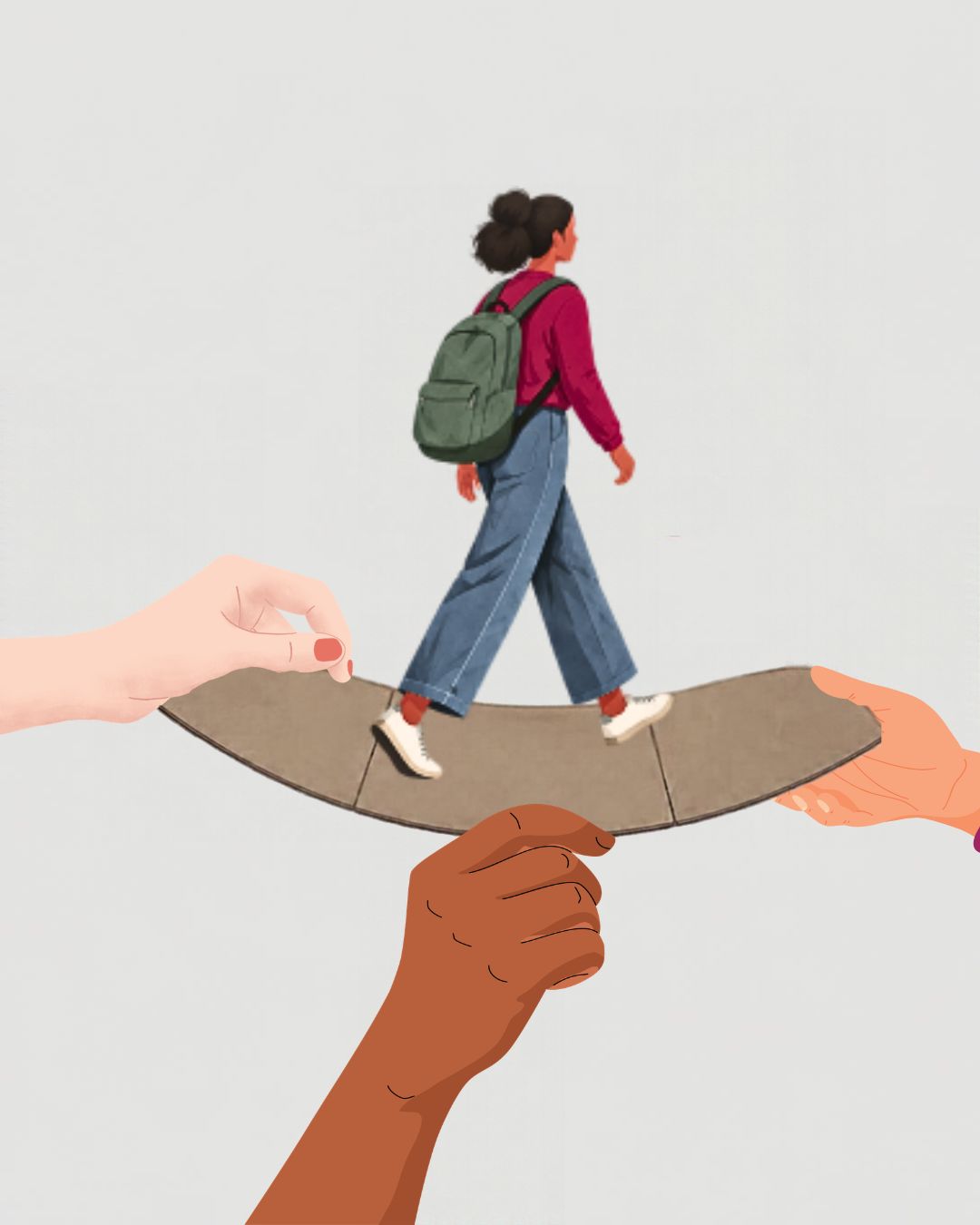
Does the higher education system grow like a city or like businesses? I hear this question, and call for action, underlying much of President Koppell's description of Montclair's commitment to advancing the common good beyond our own institutional boundaries. For him, a student's educational journey must drive our thinking. Students transfer, take courses at multiple schools, and they move between community colleges and universities. We cannot genuinely serve them, or support their success, without thinking about the whole eco-system.
There is something paradoxical and extremely elegant about this: when we focus on the individual student and commit to serving their full journey, we think bigger, not smaller. We are led to consider the
|
|
|
|
health of the larger system of which we are a part. Instead of asking only what is good for Montclair, we ask what role Montclair can play in strengthening the larger system and serving all students, not just our own.
This is the principle underlying our unification with Bloomfield College. Montclair State University and Bloomfield College came together with a deliberate commitment to realize the benefits of greater scale while preserving and magnifying what is distinctive about each. Together, we are serving more students, achieving scale without homogenization.
The same principle underlies our partnership with community colleges. They are not a source of transfer students; they are our partners in our students’ pathways to success. This is the theme of the summit we are hosting on November 2nd and described by Dr. Roman. I want to thank all of the colleagues in the colleges, Enrollment Management, and other offices who have been doing the preparatory work paving the way to this approach.
Our unification with Bloomfield College and our community college partnerships are only two examples of how Montclair State University takes responsibility for the larger ecosystem: not to make every institution the same, and not to maximize what is best for any one institution, but to recognize that a healthy system depends on the strength, diversity, and connections among its parts. This is how we are advancing the common good.
With my best regards,
Fatma
|
|
|
|
Building Student Pathways, Together
|
By Yosmeriz Roman, Vice Provost for Enrollment Management
|
|
|
|
Dear Colleagues,
On November 2, Montclair State University will bring together presidents and senior leaders from community colleges across our region around a shared purpose: making the journey from community college to a four-year degree clearer, more intentional and more seamless for New Jersey students.
This convening will mark the beginning of a new effort centered on the fundamental idea that students should not have to navigate institutional complexity in order to complete their education.
For many students, community college represents an
|
|
|
|
|
accessible and affordable entry point into higher education. Yet the journey from an associate degree to a bachelor's degree can still be unnecessarily complicated. Students may complete courses that transfer to a university but do not apply to their intended major. Others encounter different prerequisites, course sequences or program requirements that add time and cost to completing their degrees. As the university for the public good, being intentional in how we build curriculum is a part of creating access to Montclair, and is part of who we are.
Each year, we welcome nearly 2,000 new transfer students to Montclair. But a seamless pathway begins long before an application or credit evaluation. It begins with our faculty and community college partners designing the educational journey together. Through collaboration, we will work toward greater alignment between our academic programs and curricula so that students can begin their education with a clearer understanding of the entire journey ahead.
Imagine a student knowing from their first semester which courses will count toward a Montclair degree, when to transition and how long completion should take. Imagine that student also feeling part of Montclair from the beginning through campus events, student organizations and athletics. That is the experience we should aspire to create.
Our faculty and academic leaders are central to this work: aligning curricula, identifying unnecessary repetition and removing barriers in prerequisites and course sequences. Bringing colleagues from community colleges and Montclair together creates an opportunity to look across institutional boundaries and ask important questions. These conversations are about much more than transferring credits. A credit can transfer without moving a student closer to a degree. A true pathway ensures that it does both, reducing unnecessary time and expense while helping students maintain momentum.
This work on pathways also represents something larger about how we think about enrollment management at Montclair. Strategic enrollment management requires us to take responsibility for the entire educational journey, from access through degree completion and career aspirations.
On November 2, presidential leadership will establish the vision and commitment, but the work begins before that gathering and continues afterward. Provosts, deans, faculty, chairs, advisors and enrollment professionals across our institutions must collaborate program by program, supported by student development, infrastructure and systems, to turn that vision into a student experience.
New Jersey can demonstrate what happens when public institutions take collective responsibility for bridging the boundaries students navigate. Our success will be measured not by the agreements we sign, but by whether students can see a clear path to Montclair and follow it with confidence, knowing we designed it together.
We’re just getting started, and I hope you join us in the effort.
|
Yosmeriz "Yos" Roman, Ph.D.
Vice Provost for Enrollment Management
|
|
|
|
|
President Koppell's Lecture Series
|
|
|
|
American Higher Education: Foundation of Democracy, Engine of Innovation
|
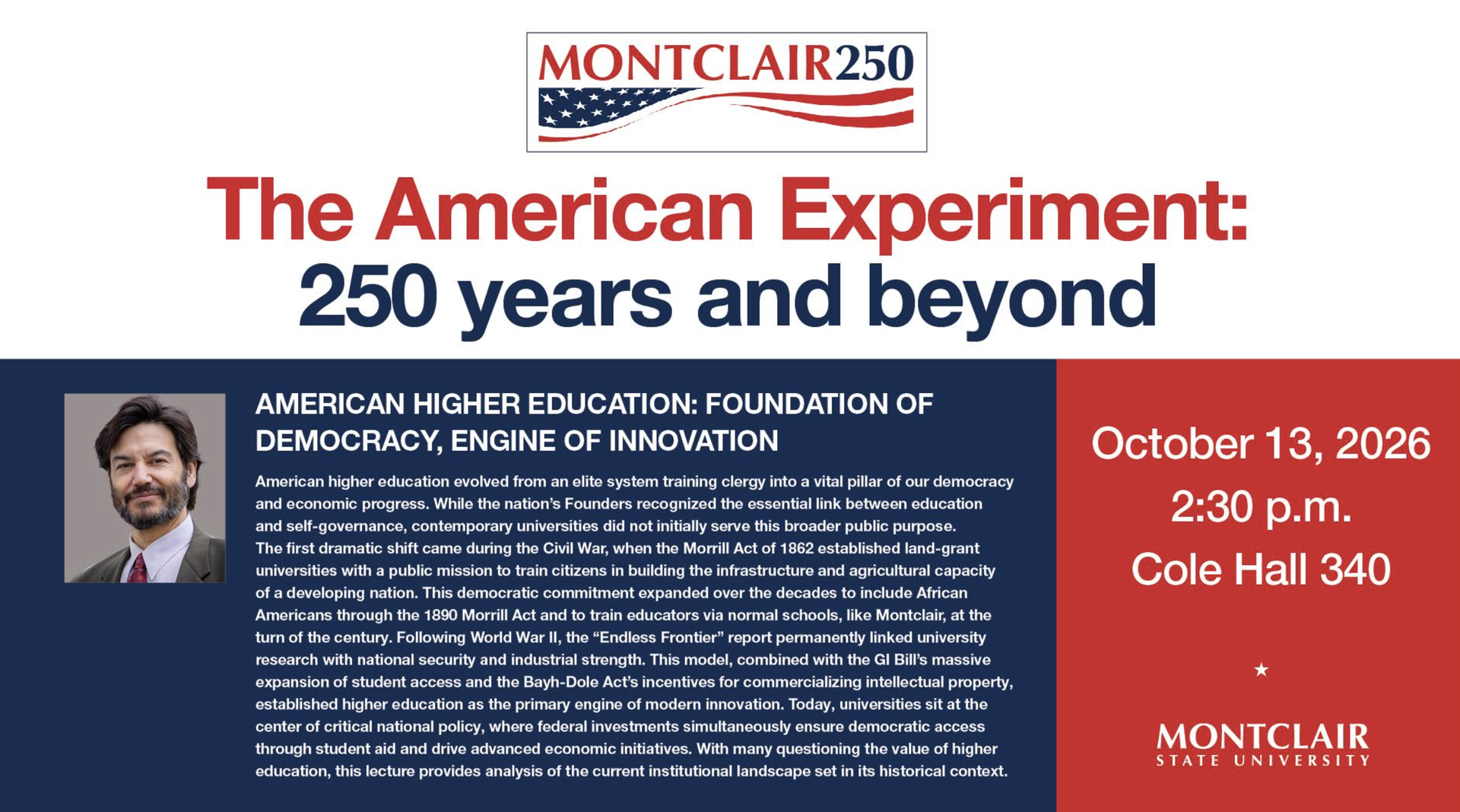
President Koppell's The American Experiment: 250 Years and Beyond continues with "American Higher Education: Foundation of Democracy, Engine of Innovation" today, October 13, at 2:30 p.m. in Cole Hall, Room 340.
Trace the evolution of American higher education as a driver of democracy, discovery and economic progress while considering today's questions about the purpose and value of universities.
|
|
|
Rethinking Our Place in the Age of AI
|
Join us Tuesday, October 27, for the inaugural event of The Wide World of Ideas, a new speaker series bringing our community together to explore timely questions and ideas shaping our world.
Educator, ethicist and author Mark Peres will lead "A New Story for the Age of AI: When Intelligence Is No Longer Exclusively Human," exploring how increasingly capable AI is challenging long-held distinctions between person and tool, relationship and simulation, autonomy and dependence—and what those shifts may require of our ethical frameworks.
The conversation will take place from 4–5 p.m. in the Feliciano School of Business, Room 140, followed by a book signing of The Accord from 5–6 p.m. Complimentary copies will be available to the first 50 registrants. Register early and join the conversation.
|
|
|
Expanding Our Proactive Student Support
|
This fall, we are expanding outreach through the Sense of Belonging Survey, identifying students facing isolation or challenges with peer support, food and housing security. Informed by four years of survey and retention data, the initiative aims to strengthen well-being and academic access. The effort is being designed and implemented by Christopher Donoghue, Danielle Insalaco-Egan, Lisha Jiang and Alker-Kelly Antoine.
The survey will be administered in randomly selected classes and emailed to all undergraduates. Results will be monitored as they come in so students reporting challenges can receive caring messages through Navigate, followed by individual meetings and direct support from academic advisors and colleagues across Student Development and Campus Life.
Instructors whose classes are selected are encouraged to administer the survey in class or share the link directly with their students. Participants can win one of 35 gift cards valued at $15–$100. Thank you to Hanan Atiyat, Jennifer Brooks, Fatima DeCarvalho, Radhika Kumavat, Kim Mason, Tara Morlando Zurlo, Jane Sanchez Swain, Kevin Schafer and Dan Stratthaus for contributing their expertise to this initiative.
We will also continue requesting Navigate midterm progress reports for undergraduate degree-seeking students. Thanks to instructors’ participation in early reports, 91% of these students received at least one message in September, helping supporters assess performance and identify outreach needs. Session A midterm reports will be requested October 12-16, and Session C one-time reports will be requested November 9-15. For questions, contact Danielle Insalaco-Egan or navigate@montclair.edu.
|
|
|
|
|
Hispanic Heritage Month Closing Celebration
|
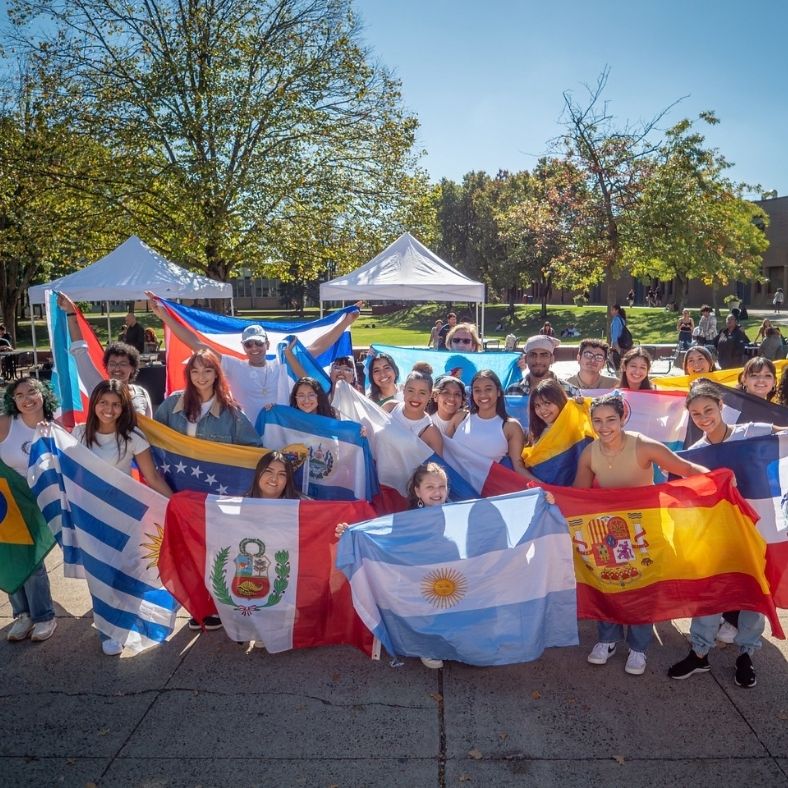
Help close out Hispanic Heritage Month at the 6th Annual Hispanic Heritage Month Block Party on Wednesday, October 14, 1-3:30 p.m. in the Student Center, Quad. Enjoy music, student dance performances, art, face painting and henna, plus frozen treats from Puras Paletas and Go Bananas (first come, first served).
Check-in begins at 1 p.m., with opening remarks at 1:30 p.m. Rain Location: Student Center, Ballrooms.
|
|
|
|
|
|
Faculty Development Opportunities This Week
|
Explore new teaching approaches at Making Meaning with Play on Wednesday, October 14, 6-7:30 p.m. Game designer and educator Eric Zimmerman will lead a hands-on workshop adapting familiar games to explore emotion and real-world issues.
Then join OFE's Teaching Unplugged Kickoff on Thursday, October 15, 3-4 p.m., to exchange ideas for encouraging attention, connection and curiosity in the classroom, and leave with one next step for your course.
|
|
|
|
|
|
'Thinking Together' with Interim Provost Mili
|
|
|
|
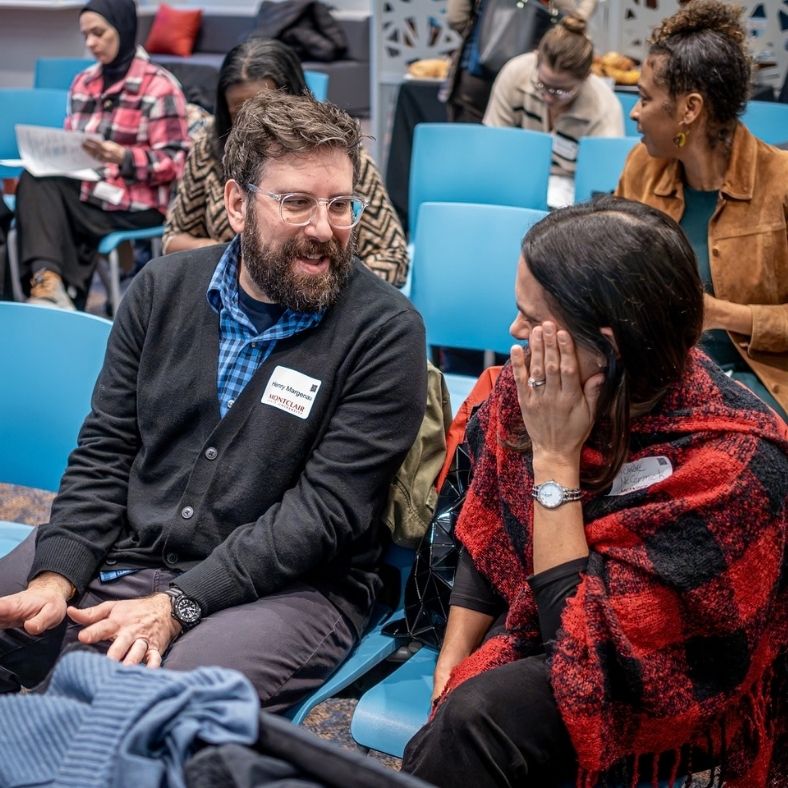
Some of the most interesting ideas begin with a question, a curiosity, or a conversation that has no predetermined outcome. I am setting up a biweekly time for us to step away from the everyday and spend some time exploring questions and possibilities that matter to the university.
Every other week, we’ll gather for an informal conversation around a question, an idea, or something worth wondering about. There will be no presentation and no expectation that we arrive with answers—just an invitation to think, listen, and explore together.
Interested in joining? Sign up here.
|
|
|
|
- Monday, October 12 - Friday, October 16: Session A Mid-Term Progress Reports due.
- Friday, October 16: Classes follow a Monday schedule.
- Monday, October 19 - Sunday, October 25: Fall Break. No classes held.
- Thursday, October 22: Community Impact Day, 8:30 a.m. - 4:30 p.m., Various locations.
- Friday, October 30: Deadline to submit a proposal for the Faculty and Staff AI Showcase.
|
|
|
|
|
|
|
Explore Previous Editions
|
|
|
|
|